
Data centers up for discussion tonight
West Chicago's City Council will consider a 180-day moratorium on new permits and approvals for data centers and battery energy storage facilities.

Update: The city council voted unanimously 12-0 on July 6, 2026 to pass the 180-day moratorium on new permits and approvals for data centers and battery energy storage facilities.
Curious residents may have noticed new construction at 1345 West Washington Street just west of the post office. It’s the site of a new data center being developed by the California-based Colovore LLC, a company that provides “ultra-high-density, liquid-cooled colocation data centers” for artificial intelligence purposes.
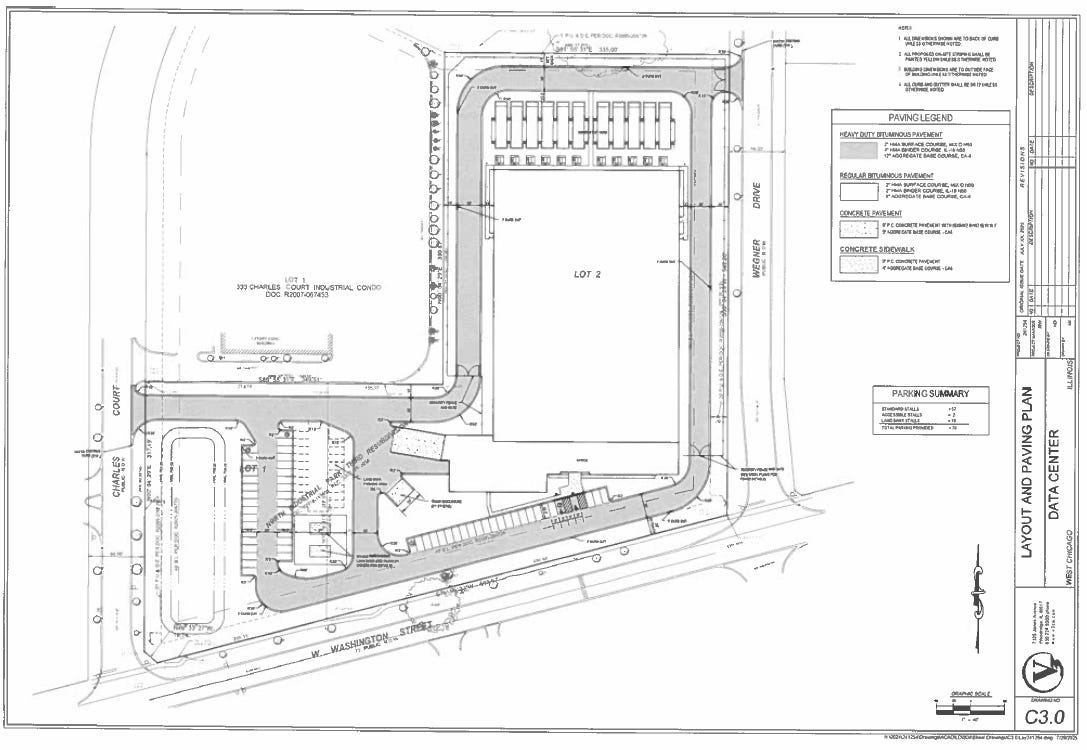
City council member Julieta Alcántar-Garcia found out about the development through the company’s request for a permit through the Illinois Environmental Protection Agency to operate a diesel generator for backup power for the new center, which would create potential air quality concerns. The company did not have to go through any special use permitting for the City of West Chicago to begin construction of the new data center.
In November 2024 the previous city council amended the city code to allow for data centers in Zone M (Manufacturing), where the new data center is located. Data centers had already been allowed in Zone A (Airport). (Zoning map here.) One data center, an 80,000 square foot facility at 603 Discovery Drive south of Roosevelt Road near Fabyan Parkway, has already been operating in West Chicago for about two decades.
Several council members, who found out about the 1345 West Washington development after construction was already underway, have requested the city place a moratorium on new data centers and battery energy storage facilities. The measure, Ordinance No. 26-O-0011, will be discussed at tonight’s city council meeting on Monday, July 6, 2026 at 7 pm at city hall. Residents are able to comment on the issue during the public participation period at the beginning of the meeting.
The ordinance can be found on page 48 of the council agenda packet. The 180-day moratorium would not prevent new data centers or energy storage development but rather “temporarily pauses new applications while the City evaluates whether additional regulations are necessary to ensure these uses are compatible with surrounding land uses and available infrastructure.”
Neighboring communities have taken similar measures. The City of Aurora placed a 180-day moratorium on data center development last September, which resulted in new regulations passed this March. The City of Naperville in January denied a controversial plan for a large data center.
At the state level, legislators failed to pass the BYONCE (Bring Your Own New Clean Energy) Bill, which would have required any new project looking to set up shop in Illinois and needing over 25 megawatts of energy to supply their own clean energy (such as wind or solar).
Data center development across the country has placed strains on local communities’ water and electricity supplies, as they require massive amounts of energy to run and hundreds of thousands, sometimes up to millions, of gallons of water per day to cool.
The new ordinance up for discussion tonight would not prevent the development at 1345 West Washington Street, though Alcántar-Garcia is hoping to include this development in the conversation. At the very least, it would open up the conversation to how the city wants to approach future data center developments.
Clarification: The original article said Colovore LLC didn’t have to go through any permitting to begin construction for the new data center. The updated article clarifies that it did not have to go through any special use permitting. It still had to go through building permitting according to city code.
These data centers wreak havoc on local communities, causing issues with air quality, the quality of life for residents, increased utility costs as the centers consume massive amounts of electricity, and water issues, among others. Any industry that negatively affects communities should be regulated, with studies completed and the public notified well before any building. This mad rush to make a buck on ai doesn't help residents, and in fact has fractured and destabilized communities across this country.
We need tough regulations on this industry that are enforceable and place our communities, people, and environment, first.